Jul 29, 2026
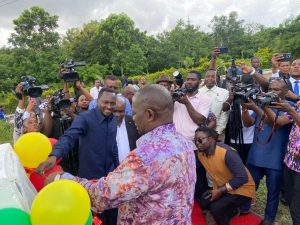
Lands Minister Armah-Kofi Buah commissioning the upgrade of the national seismic network with GGSA Director-General, Dr. Propsper Akaba
Accra, Ghana — The Government of Ghana has officially commissioned the upgraded National Seismic Monitoring Network, marking a significant milestone in the country’s efforts to improve earthquake detection, monitoring, and disaster preparedness.
Speaking at the commissioning ceremony, the Minister for Lands and Natural Resources, Emmanuel Armah-Kofi Buah, described the project as more than the installation of new equipment, calling it a demonstration of the Government’s commitment to protecting lives, livelihoods and critical infrastructure from earthquake-related hazards.
“Ghana has experienced several damaging earthquakes throughout its history, including major events in Axim in 1636, Accra in 1862 and 1939, and Ho in 1906. The 1939 Accra earthquake, estimated at magnitude 6.5, remains one of the most devastating natural disasters in the country’s history”, he recalled.
The Lands Minister noted that recent seismic activity, including the March 6, 1997 tremor and recurring earth movements recorded between 2018 and 2023, indicate that major fault systems in south-eastern Ghana remain active. He stressed that while earthquakes cannot be prevented, the country can strengthen its ability to detect, understand and respond to them.
As part of Government’s flagship programme of the resetting agenda, the Ghana Geological Survey Authority (GGSA) replaced obsolete equipment, rebuilt and re-equipped remote seismic stations, and upgraded communication systems from aging satellite technology to modern cellular telemetry. The improvements now enable real-time transmission of seismic data to the national observatory.
According to Hon. Armah-Kofi Buah, 20 of the country’s 21 seismic monitoring stations have been fully upgraded and are operational. The 13 strong-motion stations monitoring the Weija, Akuse and Akosombo dams have also been modernized. In addition, broadband stations are now capable of recording both ground-motion velocity and acceleration with greater precision.
He said the upgraded network will enable faster earthquake detection, accurate location, magnitude determination, real-time alerts and enhance data collection to support improved seismic hazard maps, inform building regulations, land-use planning, and infrastructure development.
He disclosed that beyond earthquake monitoring, the network will help safeguard critical national assets, including dams, ports, railways, bridges, energy facilities, and future nuclear power infrastructure. It is also expected to support safer mining operations through improved monitoring of seismic activity associated with blasting and underground mining activities.
In his welcome address, Director-General of GGSA, Dr. Prosper Akaba, recalled that the Authority has a proud history of earthquake monitoring since the colonial era. “Between 1914 and the early 1930s, the then Gold Coast Geological Survey Department operated a Milne Single-Boom Seismograph. This evolved into an analogue seismic network established in 1978 and later an eight-station digital network and stand-alone strong motion accelerographs on the country’s major dams in 2012 and 2015.”
“Today, we are commissioning a modernized seismic monitoring network incorporating broadband seismometers, strong-motion accelerographs, solar-powered remote stations, advanced telemetry systems, and modern data acquisition, processing, archiving, and event notification platforms”, he said proudly.
Jun 19, 2026
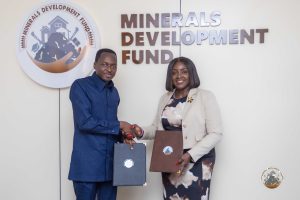
Dr. Akaba in a handshake with Dr. Hanah Bisiw following the signing ceremony
The Ghana Geological survey Authority (GGSA) has signed a geological services agreement with the Minerals Development Fund (MDF) to scale up government’s effort to boost responsible mining across the country.
The agreement provided a framework within which GGSA will conduct comprehensive geological investigations in “blocked-out” areas assigned to MDF by the Minerals Commission.
Geological investigations will assess the economic value of mineral deposit underground as well as the environmental risks in those areas.
The agreement, signed on Monday 13th April 2026 formed part of multiple approaches deployed by government to improve data-driven targeted mining at the small-scale levels as well as make illegal mining unattractive.
GGSA Director-General, Dr. Prosper Akaba, noted that “With proper investigations, we can ensure that mining activities are conducted in areas that minimise environmental risks and maximize economic benefits”.
Dr. Hanna Louisa Bisiw-Kotei, Administrator of the MDF, called it a turning point in how Ghana manages its mineral wealth at the grassroots level.
“We are giving communities the tools, data and legal backing to mine responsibly, protect their environment and benefit sustainably from their natural resources,” she said.
Jun 9, 2026
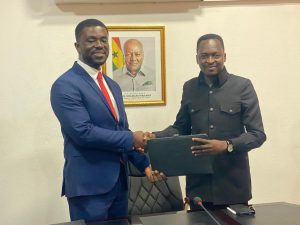
Dr. Prosper Akaba, GGSA D-G (right) exchanging MoU document with Mr. Seth Miah, the West Africa Regional Manager of Seequent
Accra, Ghana — The Ghana Geological Survey Authority (GGSA) has signed a Memorandum of Understanding (MOU) with Bentley Systems International Limited, operating through its geoscience division, Seequent, to strengthen Ghana’s digital geoscience capabilities and modernize geological data management and analysis.
The agreement establishes a one-year collaboration aimed at enhancing GGSA’s expertise in digital geoscience workflows through access to advanced geological modelling software, specialized training, and the exploration of future areas of cooperation.

Dr. Prosper Akaba, GGSA D-G (right) exchanging MoU document with Mr. Seth Miah, the West Africa Regional Manager of Seequent
GGSA Director-General Dr. Prosper Akaba, who signed for the Authority, said the partnership aligns with its mandate to support sustainable economic development through science-driven decision-making.
The West Africa Regional Manager of Seequent, a global leader in subsurface modeling and geoscience software solutions, Mr. Seth Miah, disclosed that Bentley Systems will provide GGSA with a suite of industry-leading digital tools to support geological interpretation, visualization, and resource evaluation.
Under the agreement, GGSA will receive five annual subscriptions each for Leapfrog Geo and Leapfrog Edge, one annual subscription for Res2D/3D, and Oasis Montaj.
The software will enable GGSA’s technical teams to improve geological modelling, resource estimation, and data integration processes. Access to the software will be governed by both parties against unauthorized intrusion.

A key component of the collaboration is capacity building. The parties have agreed to organize three training sessions focused on Leapfrog software and related digital geoscience workflows. Details regarding the timing, content, and delivery format of the training programmes will be finalized jointly.
Beyond software deployment and training, the MOU provides a framework for exploring additional collaborative initiatives that support the objectives of the partnership. Any future activities involving research, development projects, extended software subscriptions, or other commitments not specified by the MoU will be governed by separate agreements.
As part of the collaboration, GGSA has committed to making appropriate personnel available to participate in training sessions, utilize the software products, and assess opportunities to integrate Leapfrog solutions into its geological modelling and resource estimation workflows.
The Authority will also work with Bentley Systems in developing a case study documenting the outcomes of the collaboration and may participate in mutually agreed public awareness and reference activities.
The total value of the software licenses together with the training in the use of the licenses stands at about $300, 000.00

May 13, 2026
KUMASI — The Kwame Nkrumah University of Science and Technology (KNUST), through its Department of Geological Engineering, has officially signed a strategic partnership with the Ghana Geological Survey Authority (GGSA). The agreement is designed to elevate geoscientific research, enhance student training, and foster robust knowledge exchange between academia and the public sector.
Speaking on the agreement, Prof. Edmund Ekuadzi, Dean of the International Programmes Office, characterized the collaboration as a welcome reunion of long-standing partners dedicated to advancing geoscience education in Ghana.

Provost of the College of Engineering, Prof. Kwabena Biritwum Nyarko
While informal collaborations have existed for years, Provost of the College of Engineering, Prof. Kwabena Biritwum Nyarko, emphasized that this new framework provides the structure needed to scale their joint efforts. Key initiatives will include joint research projects, student internships, and staff collaboration aligned with national development goals.
“We want GGSA to support the strengthening of our laboratories so we can deliver improved services to the country and enhance student training. We also intend to work together to secure external funding and technical support to drive national development,” Prof. Nyarko stated, adding that the partnership will also feature joint seminars, workshops, and career fairs.

Director-General of the Ghana Geological Survey Authority, Dr. Prosper Aduah Akaba.
Director-General of the GGSA, Dr. Prosper Aduah Akaba, reaffirmed his institution’s commitment, noting that the agreement stems from high-level ministerial directives and has been vetted by the ministry’s legal team. He also highlighted that KNUST and GGSA are already actively collaborating on staff development and research.
KNUST Vice-Chancellor, Prof. (Mrs.) Rita Akosua Dickson, welcomed the delegation and reiterated the university’s focus on impactful, problem-solving research.
“We are impacting our students, our communities, Ghana, the sub-region, Africa, and ultimately the world. That is what this partnership represents,” Prof. Dickson affirmed, assuring the GGSA that KNUST is fully equipped and ready to execute the agreement.

Mar 9, 2024
The Ag. Director-General of the Ghana Geological Survey Authority(GGSA), Mr. Isaac Kuuwan Mwinbelle has opened a 2-day Experience Sharing Workshop with a call on Technical Staff from the various regions to show interest and commitment in enhancing their capacity
In his opening remarks at the workshop on Thursday, 7th March, 2024, the Director-General said the training workshop is expected to enhance the capacity and competence of all technical staff to undertake their mandates as assigned to them.
He emphasized that the training program is also an avenue for Team leaders to share experiences in projects undertaken in the regions, their findings and challenges overcomed.
The Ag DG urged participants to take the workshop very serious and give it full participation to derive maximum benefits while making relevant inputs to meet targets set by the end of June and November, 2024 respectively.
Mr. Mwinbelle assured that , at the end of the capacity workshop, management will take into consideration all suggestions made and also provide the needed solutions to challenges raised.
Project Team leaders took turns to discuss detailed presentations highlighting on the economic and mineral potentials identified, Geological mapping & Pegmatite investigations, Regional Geochemical soil sampling among others.
With pictorial slides, the Teams also informed participants about the methodologies and equipments used for their field work observations.
The workshop afforded participants the opportunity to ask questions and make contributions which hopes to improve the work output of the Authority.
Source: MLNR
